Showing posts with label lowell photos. Show all posts

Wednesday, March 13, 2024

Lowell National Historic Park-the Final Part

        Hi everyone. Today's post is a scheduled post since I am now (hopefully)  in Greece.  However, I did want to finish my Lowell National Historic Park posts because I know that when I come home, there will be other things to share. 😏

    For this last post about the National Historic Park we'll be heading to a boarding house museum where, in the early years of Lowell's manufacturing history, the women employed by the mills would live.  The first 2 parts of this visit, if you're interested, can be found here Part 1 and Part 2.

     These boarding houses were very close to the mills themselves, so the mill girls (as they were called) could easily walk back and forth not only at the beginning and end of the day, but also for their meals. 


      That brick building behind this park is one of those boarding houses. A lot of the mill girls  came from farms in the area up to a few hours away from the mills. At that time, New England farms could be pretty tough places to live because most farmers were not wealthy, and farm work was not easy or leisurely work either. The soil here is rocky; there are so many trees to clear and keep clear, and the winters are fairly long (in comparison to other places). Never mind that the small family farms meant there were always animals to care for or crops to deal with. And on top of that, there was the normal day to day living for women which included cooking,cleaning, keeping  fires going, and helping out with child care.

     A lot of the stories the museum shared  talk about girls who felt they had a chance to get out in the world by going to work at a mill. Besides work, there were concerts, parties and often church related events the workers could attend.

    However, keep in mind, the workers were at the mills 6 days a week,  many day for 12 (+)  hours, so even though these girls were out in the world, it's not like they were socialites who slept in and went to glamorous balls. (And the question is, did they really escape to better conditions?)


Here's a boarding house bedroom where several women slept and even shared beds. 


And this is part of the dining room where the women shared communal meals.

And you might not be able to read these next few photos, but the meals the girls were fed were pretty hearty sized meals. This exhibit showed typical breakfasts, lunches and dinners. 


As you can see, it was not a glamorous life. 


Over time, the overall make up of the mill workers changed, especially as other opportunities for women came into being. As immigrants arrived from other parts of the world, they began to fill those mill jobs. 

However, when the mills shut down, it did create a lot of hardship. New England is filled with mill towns, some textiles, some not. Even some farming communities had small mills, including my town where we have under 3,000 people today and  where there were fewer in the past.  Was it an easier life than farming? I don't know the answer to that question, but as the west opened up with better farming land, many New England farms ceased to exist. Mills became a place for people to make their livelihood. The forests grew back.  People left the country and went to the city  where there were more opportunities.  Immigrants arrived from various places in the world.  And the economy in New England over time, as it is in many places (and as many of you probably already know) has changed from manufacturing to white collar and service jobs.

However, I think the history of an area is always interesting to glimpse. The history of the Lowell Mills might have begun as a unique commercial project, but it does reflect one part not just of Lowell's story, but in New England's history as well. 


I'll finish this post with  a view of a mill and the same park (only a different view) as my first photo.

That's all for me today. I'll "see" you back in the blogosphere when I return home at the end of next week. 


Friday, March 8, 2024

Lowell National Historic Park-Part 2

 Hi everyone. Happy Friday. It's almost the weekend too, so for many people, it is almost time for a little down time. 😏

And FYI-today's post is a bit on the long side. 

    This past Wednesday I shared some photos and info from a trip last month to Lowell National Historic Park in Lowell, Massachusetts. My daughter and I  visited this park back in early February when she had some vacation time before starting a new job. Here's my Wednesday post if you're interested in reading it: Lowell National Historic Park-Part 1.

    Since it is time for Nicole's Friday Face Off and also for Gillena's Friday Lunch Break , I have some face photos today, as well as some photos from the museum at the Historic Park.  The museum is on the floor above where the park has a large number of actual still working looms.


   This historic park had me thinking about Fabric/Textiles, and how it is one those "things" that most of us probably take for granted.  Textiles are all over the place; in clothing, linens, towels, curtains, rugs and other items too. I'll use clothes as an example. 

    We go to a store or go online and buy clothes. Or perhaps we get second hand clothes from someone. Or maybe you even sew and just get the fabric to make your clothes.  Obviously we couldn't have clothes without the fabrics that make them. (Unless we shot all the animals and ran around in fur, but that would definitely decimate the animal population. 😒) I don't know about you, but other than the type of fabric something is, I don't usually think about what it takes to make  the fabric. 

  I can see why weaving fabric by hand would take up so much of a household's time before mechanization came into play. Clothes were needed for warmth, privacy and protection. Yes fabrics could be bought, especially specialty materials like silk, but it was often out of the budgets of many people. It also explains why clothes closets were small or weren't even put into many older homes.  People didn't need them because they didn't have all that many outfits. Unless of course they were wealthy.

   Mechanization was good for fabric production, even though there were a lot of negatives too. Not only were the early workers subject to long days, no safety constraints, and relatively poor working conditions, there were also nasty environmental effects like  dyes and other discharges.  I could probably write a whole post about the pros and cons of mechanization, but I think you get the point without me doing that. 

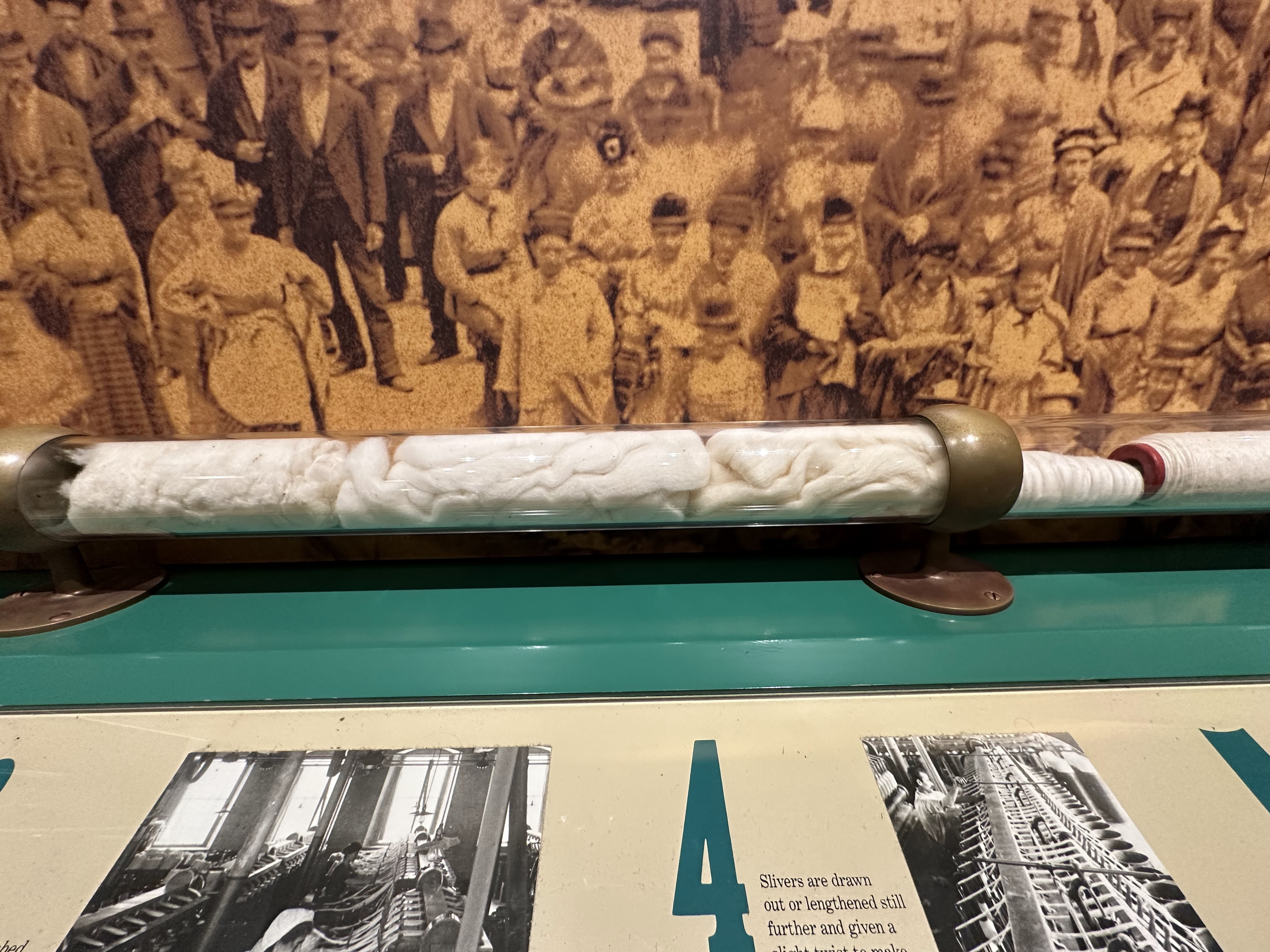
       The mills in Lowell were historically  about making cotton fabric. I liked this glass tube they had in the museum that showed the results of the entire process, starting with  the actual cotton. To keep this short, I'm not writing about each step but you can see in the photos how the original cotton changes to become, eventually, fabric.


The cotton must be cleaned and then spun to be  turned into thread.


The thread is woven into  cloth, which might need to be whitened before it is finished.


 And it might then need to be dyed to create colorful threads, or perhaps the entire sheet of fabric is dyed.


And then you get bolts of fabric.
 (Sorry for the lousy clarity on this next photo. I think I smushed my finger over the lens on my phone before I took this photo.)


After production,  the bolts of fabric have to be shipped to their destinations.


      I really like this (above) photo because of the perspective of the museum display with  my daughter. She loves fabric, as you can see from  all the various types in her outfit. She also is a clothes horse extraordinaire. And she is a pretty decent quilter too.

     Historically, the importance of making textiles was right up there with getting food. The oldest garment found to date (based on my internet search as I am not a fabric expert) was from somewhere between 3482-3012 BCE/BC in Egypt. You can see it and read about it here if you are interested: Tarkhan Dress. Sadly, fabric doesn't often survive the millennia things like pottery, sculpture, tools and buildings do, and a lot of early archaeologists didn't  bring the importance of fabric front and center in the research, mainly because even they found it, it wasn't showy and usually very decayed. 

      I was also reading about natural versus synthetic fabrics. Although natural fabrics (cotton, wool, linen and silk) come from non-man made sources, man manipulated those sources in order to have the fibers to make fabric. One example  is how sheep have been bred for millennia to have more wool, and wool that does not shed. The ancestors to today's sheep shed their woolly "fur" or had people pull it off. (Rather like having a shedding dog and pulling off clumps of hair.) Sheep are most likely the second oldest domesticated animal right behind dogs because wool makes fantastic yarn then used to make fabric.

     There are books written about textile production, types of textiles, uses of textiles, etc. I've read quite a few, but this is a blog post (and it's already pretty long) and not a book about fabric.

OK, this is enough for one post. I'll end this post on the lighter side with a selfie my daughter took of herself and me on our day out.


If you're interested my final Lowell Park post will be scheduled next Wednesday.

I hope my look at fabric wasn't too boring.  I will be missing the next couple of weeks of Friday Face Offs and Friday Lunch Breaks as I'm heading out on a long planned and twice postponed girls trip. 
Have a super weekend.


Wednesday, March 6, 2024

Lowell National Historic Park-Part 1


 Hi everyone. Happy mid-week to you. 

Back at the beginning of February my daughter was on vacation before she started a new job. We met one day in southern New Hampshire and took a little trip  to Lowell National Historic Park in Lowell, Massachusetts.

   In the 1810's, some business men met and decided they would build textile manufacturing mills along part of the Merrimack River in an area of Massachusetts close to the southern  New Hampshire border. They also planned out living places and other needed resources so their  mill workers could have a life close to where they worked.  Their ideas created the first planned industrial city in the United States. 

   This new development was called Lowell,  named after Francis Cabot Lowell, one of those business men. F.C. Lowell had visited England to see how their textiles were produced. He memorized the construction of these British looms so similar automated looms could be built when he returned to the United States. At that time, the design of those British  looms was top secret.  Lowell was able to come back to the US and build a replica. With that replica, the start of American cotton fabric production went into full swing.  Although he did not live long enough to see the  planned mill complexes built (F.C. Lowell died in 1817), the rest of the men decided to name the city after him.

   At one time Lowell, Massachusetts was the largest textile producing area in the United States. The industry was going strong until it became cheaper to produce cloth in the southern US (where the cotton was grown), and then eventually, cloth production was shipped overseas. When the mills went out of business, Lowell went into a deep economic decline.  It was then that some of the old mills  became a National Historic Park to commemorate and be a teaching tool about that part of US history. 


The National Park Service operates some historical museums. In the photo above you can see some boarding houses where the women who worked the mills lived. Part of this building is now a museum. I"ll share that in a future post.

Below are the canals and some of the mill buildings from the mill complexes. The park service operates a museum in the Bootts Cotton mill.


Inside the old Bootts mill, there was one floor still filled with old weaving machines. On the floor above the machines, there was an interesting small museum about the mills.


I can only imagine how loud the entire building was when all the stories were filled with running machines.  When we entered some park rangers started up a section of machines to run, and my ears were ringing when I left.


Plus the cotton fiber dust must have been horrible to breathe in. Factory  worker safety was obviously not like it would be today. You could see the fibers stuck all over the machines.


The roll of the workers (mostly women) was to be sure that the thread spindles were constantly put in and that the machine was actually producing fabric. This is because the machine could weave the fabric automatically, but these older machines weren't robots and needed a person to keep them working. Here are some of those loaded spindles, ready to go onto a loom for fabric production.


Finally for today's post, here's some fabric that was currently being made in the mill. The park service cuts and sells this fabric to help support the park.


I'll share more on Friday. Thanks for visiting. 


Monday, November 6, 2017

T Stand for Hockey Season

Happy Tuesday folks. Today is the day we stop by Bleubeard and Elizabeth's blog  and share a little drink fun. And sometimes  we even share some food or other adventures.
After all T is for Tuesday.
I have a little road trip fun for you today.
My T Day post is all about what the hubby and I like to do in the winter.
We like to watch hockey. Our favorite team is our college team, The University of Maine Black Bears.
Our college  used to have a strong and competitive team that was hard to beat. Lately they've gone downhill. In fact, they hadn't won an away game since January of 2015. 
But last Saturday they were playing the University of Massachusetts Lowell. Lowell is about 1 1/2 hours away from out home (half the distance of going back to our alma mater) so we got tickets for the game.
We were meeting my husband's sister and her husband (he's an alumni also) as well as my husband's cousin and his wife who just wanted a day out.
The game was at 4PM so before the game we met for lunch and a couple of pre-game beers, plus we had a little walk around the city of Lowell.
Lowell is an interesting place.  It began in the 1820's as an experimental factory city. Since the Merrimack River ( a large New England River) runs through the city, it made a good place for many early textile mills to be built. It was the first planned  and highly successful industrial city in the United States. After mills went out of business, the city suffered, but now there is a US National Historic park where you can learn about those mills and the lives of the mill girls back in the 1800's. The city has made a comeback and is actually an interesting place to visit.
Here's a few photos from my walk. 

 Here's an old trolley station and also a mill canal. I believe there were 6 miles of canals built throughout the city.


 And this is the arena where we went to watch the game. I will say it is one of my favorite venues. It is called the Tsongas Center, named after an influential Massachusetts legislator who hailed from Lowell.
I wish I had more of the historical mills to show you, but we didn't walk into that neighborhood. I visited the Mill Museum back in 2007 and maybe it's time to go back again. Here's a link to the National Historic Park Site if you are interested: Lowell National Historic Park. Maybe next spring or summer once they open up for another season I will make a point of going back.
Part of the reason we only had so much time was we were all meeting for lunch at an Irish Pub called The Old Court.

It certainly had some personality. And some cool wall art . I should have taken the wall art photo before the place got crowded.
But they did a a good beer selection.
My husband and I both had a Southwick's Red Ale which is made by Guinness and imported from Ireland. It's a nice drink.
And 4 out of the 6  of us had fish and chips for lunch.
I substituted onion rings for my chips. It was delicious and not greasy at all.
And after lunch we walked back to go to the game. Our team actually won, 6-2. Wahoo.
So a good time was had by all.
Thanks for visiting.